
Solution
OTT middleware integration
Apps that connect properly to the middleware you run — or a middleware path alongside them.
- What has to line up
- Catalogue
- Sign-in
- Entitlements
- Playback
- Billing
- Where the work actually goes
- Entitlements
- Rights windows
- Device limits
- Ours or yours
- Apps ours
- Middleware yours
- Boundaries agreed
The part nobody sees, on the screen where they do
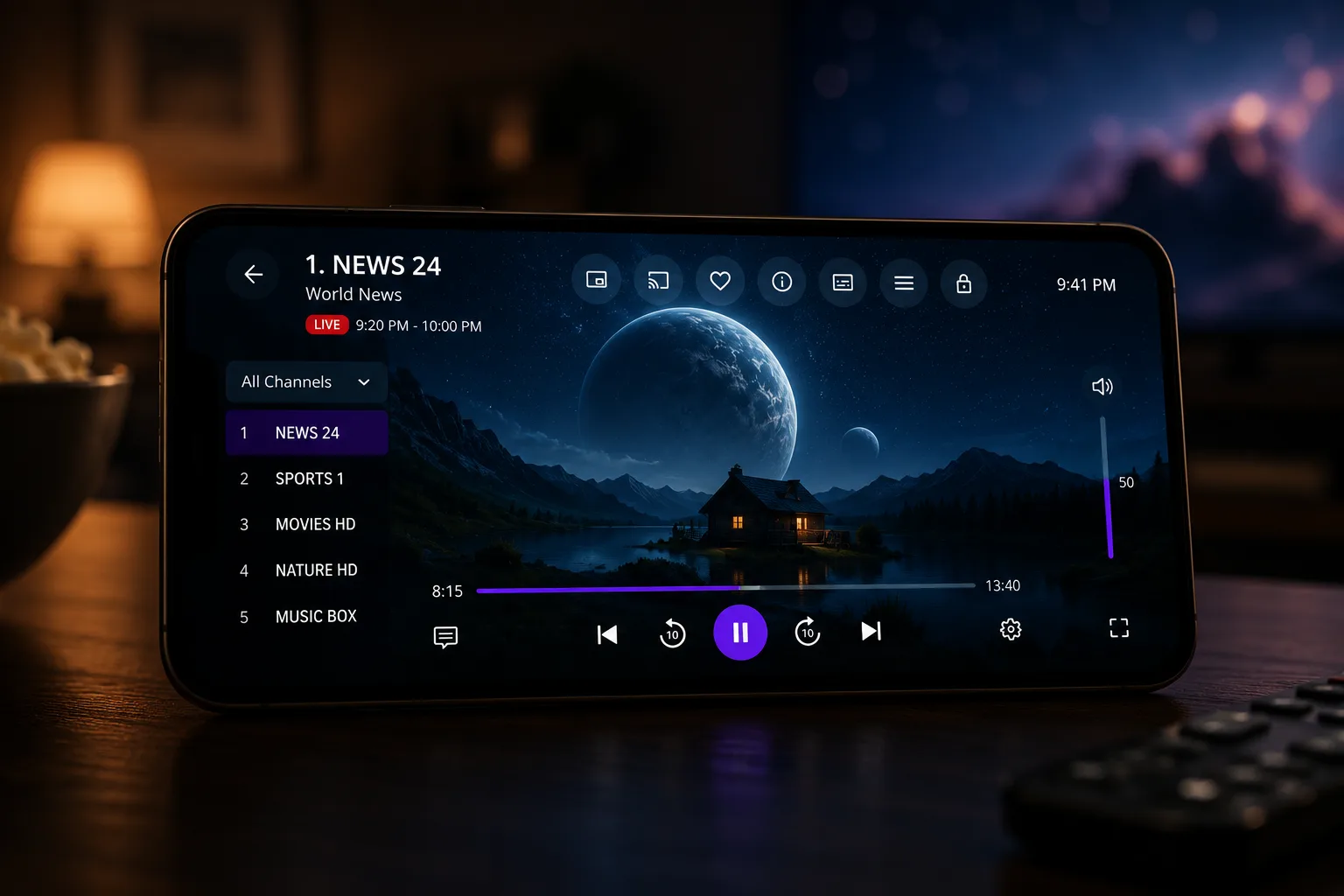
All of this came from somewhere else
The channel list, the programme running until ten, the badge saying it is live — none of that is in the app. It is the middleware's catalogue and schedule, arriving over an interface and rendered here. When the two disagree about what a viewer is allowed to watch, this is the screen where it shows up as a support ticket.
What you get
- Apps connected to your existing middleware, with the entitlement rules honoured
- A written record of what the platform does not do, agreed before work starts
- One supplier conversation covering the apps and, if you need it, the middleware path
- Responsibility boundaries agreed with your platform vendor in advance
- The same rules enforced identically on every platform you ship to
Typical timeline
6 weeks to 3 months, depending on the middleware
Who this is for
Operators, telcos and ISPs who have a back office and need apps on top of it — and services that have neither and would rather not run two procurement processes to get both.
OTT middleware is the part of a streaming service nobody sees: the system that holds your catalogue, knows who your subscribers are, decides what each of them is allowed to watch, and bills them for it. IPTV middleware is the same job where set-top boxes are involved. The apps are what your viewers touch. Getting the two to agree is the work on this page.
OTT middleware integration
Starts with a platform that does most of what you need, and an app team discovering the rest in week three.
IPTV middleware
Starts with set-top boxes you cannot replace, and apps that have to agree with them about who can watch what.
Integrate OTT middleware
Starts with interface documentation written a while ago, describing a system that has moved since.
OTT middleware provider
Starts with no platform chosen yet, and no appetite for running two procurements to get one service.
What we deliver
Apps that connect properly to the middleware you run, or apps and a middleware path together if you do not have one yet.
Most of this work is the first kind. You have a platform, it does what it does, and the job is to integrate OTT middleware you already own with apps that arrive expecting something slightly different. Catalogue, sign-in, entitlements, playback. The interesting problems are almost always in entitlements, because "who is allowed to watch this" is rarely as simple as the documentation makes it look.
For the second kind, our technology partner is MwareTV. Their materials describe a cloud-native platform built around a management system they call TVMS, with modules covering content, billing, subscribers, marketing, reporting and apps, and multi-DRM support — PlayReady, Widevine and FairPlay — through an integration with Irdeto. Their rights tooling is documented as tracking licensing windows, territories and device limits per title and enforcing them automatically, which is the part most operators underestimate.
How the integration runs
OTT middleware integration is mostly a mapping exercise, and it fails in predictable places. We start by finding out what your middleware genuinely exposes, rather than what its documentation says it does. Those differ often enough that assuming otherwise is how integration projects slip.
Then we agree the gaps in writing. Every platform has things it does not do, and the choice each time is to work around it in the app, ask the platform vendor for it, or drop the requirement. Making that call explicitly, early, with both suppliers present, is most of what stops the awkward conversation later.
Find out what it really exposes
Not what the documentation says. Those differ often enough that assuming otherwise is how these projects slip.
Agree the gaps in writing
Work around it, ask the vendor for it, or drop the requirement. Decide explicitly rather than discovering later.
Map the entitlement rules
Who can watch what, where, until when. This is where integration work actually goes.
Build once, enforce everywhere
Every app has to apply the same rules identically, or the gaps become support tickets.
Settle who owns what
Agreed with your platform vendor before launch, not during the first incident.
What actually varies
We do not publish a price. Here is the more useful thing: what moves it.
| Driver | What it changes |
|---|---|
| How complete the middleware's interfaces are | The biggest factor by some distance. A well-documented, stable interface is a short job. One that changes underneath you is not. |
| How complicated your entitlements are | One subscription tier is straightforward. Regional rights, device limits and time-boxed access are where integration work actually goes. |
| Whether you are also migrating | Connecting new apps to an existing platform is one project. Changing both at once is a different one, and it should be sequenced rather than merged. |
| Number of platforms | Each app has to hold the same rules, and each store reviews separately. |
Two limits worth saying plainly, because between them they should tell you whether to call us.
We are not a neutral adviser on which middleware to buy. We have a partnership with MwareTV, and that is a real bias rather than a disclosure formality. If you want genuinely impartial platform selection, hire someone with no app business attached to the answer — then come to us for the apps once you have chosen.
If your platform's own app builder covers it, use that. MwareTV's is documented as generating branded apps for more than fifteen platforms from a single configuration. A custom build earns its cost when the app itself is what your viewers judge you on, or when you need something the platform was never meant to do — otherwise the builder, or a white-label route, gets you there for less, and we would rather say so than quote you for work you do not need.
What we need from you
- Which middleware you run, or that you have not chosen one yet. Both are fine answers.
- Your interface documentation, and someone who can tell us where it is out of date.
- Your entitlement rules in full, including the awkward ones nobody has written down.
- Who owns the relationship with your OTT middleware provider, because integration questions become their questions quickly.
You will be talking to the people doing the work, which matters here because the useful early conversation is about what your middleware cannot do, and nobody enjoys having that one late.
Common questions
Do we have to use your middleware partner?
No. Most of this work is connecting apps to middleware a client already runs, and that is the normal case rather than the exception. The partnership exists so that a client without middleware can get both from one conversation, not so that we can push one option.
We already have middleware. What does integration actually involve?
Mapping what your system exposes to what an app needs, and being honest early about the gaps. Catalogue, sign-in, entitlements and playback all have to line up, and the interesting problems are usually in entitlements — who is allowed to watch what, where, and until when.
Can the middleware just build our apps?
Sometimes, and if it can, you should let it. MwareTV's no-code App Builder is documented as generating branded apps for more than fifteen platforms from a single configuration. If that covers what you need, it is the cheaper answer and we will say so rather than quote you for a build.
Who is responsible when something breaks?
Agree that before you sign anything, with both suppliers in the room. The failure that costs you a weekend is the one where the app vendor and the platform vendor each have a plausible reason it is the other one.
Related
Last updated