
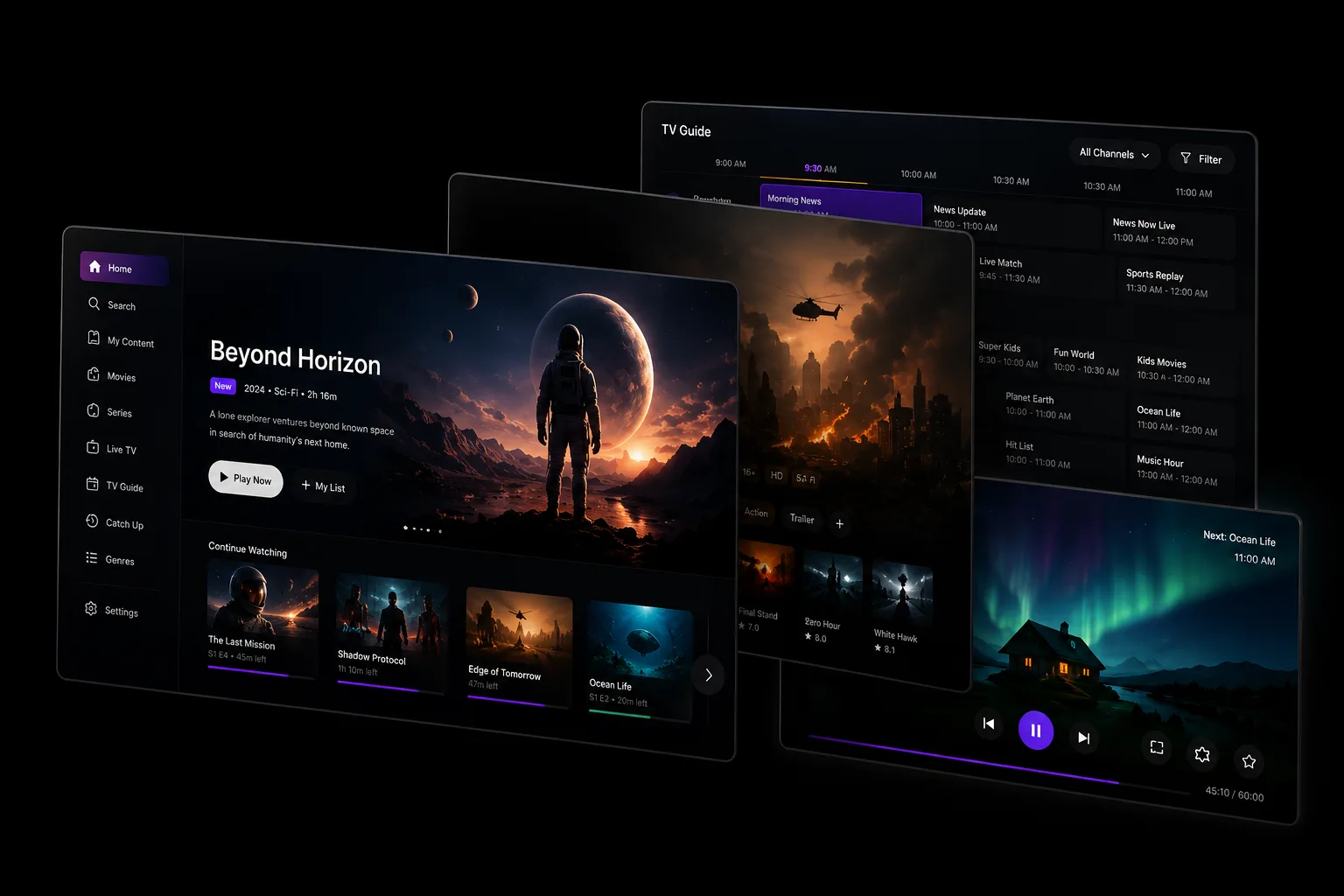
Solution
Multi-platform expansion
You are live on some screens. Here is what it takes to reach the rest.
- Carries over
- Catalogue
- Sign-in
- Entitlements
- Business rules
- Brand
- Rebuilt per family
- Navigation
- Focus
- Playback
- Layout
- Where teams usually stop
- Consoles
- In-car
- Newer TV platforms
The same service, one screen family at a time
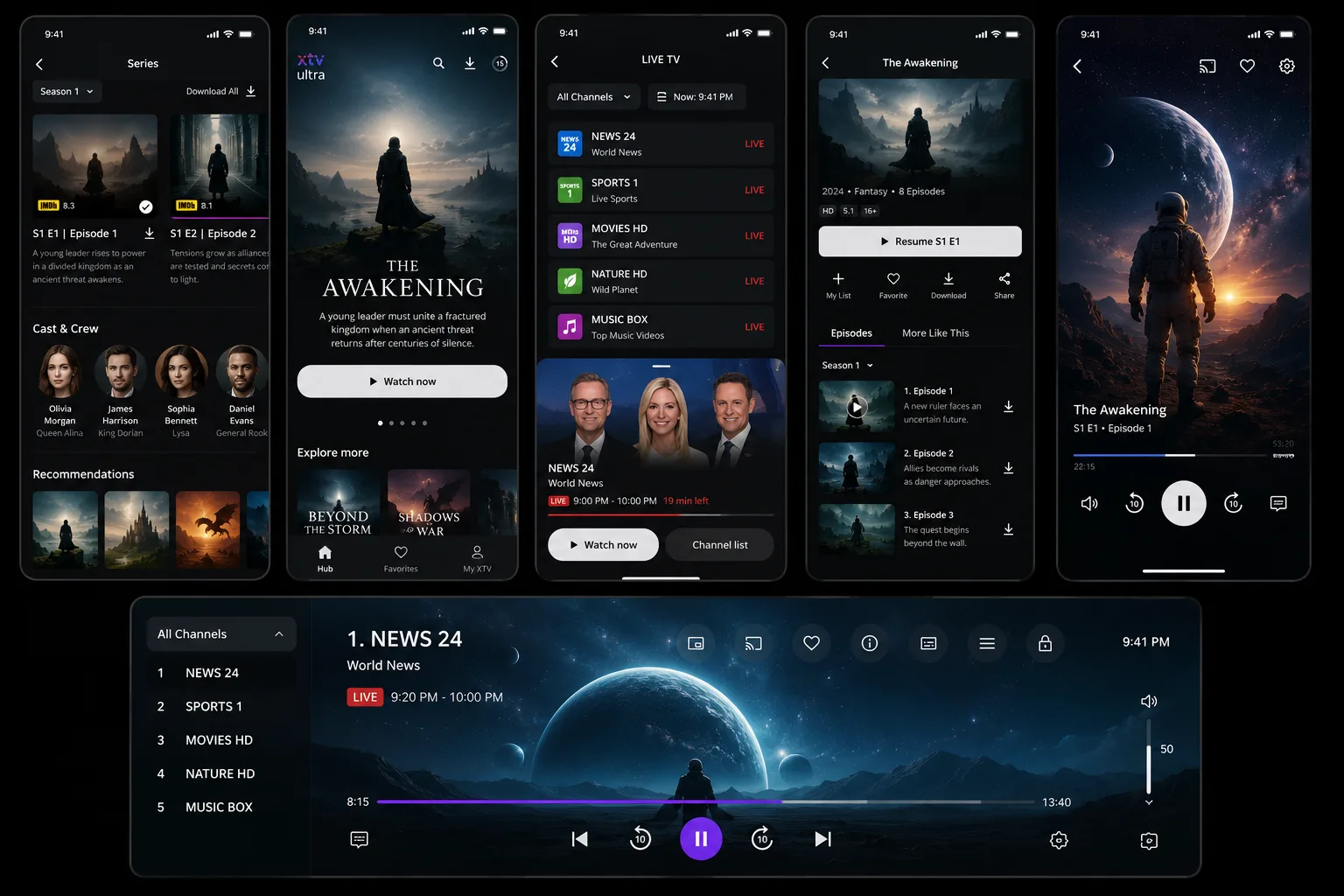
Where you probably are now
A phone app and a website that work. This is where a service usually sits when it lands on this page, and it is where most of the market stops — which is the opportunity, not the problem.
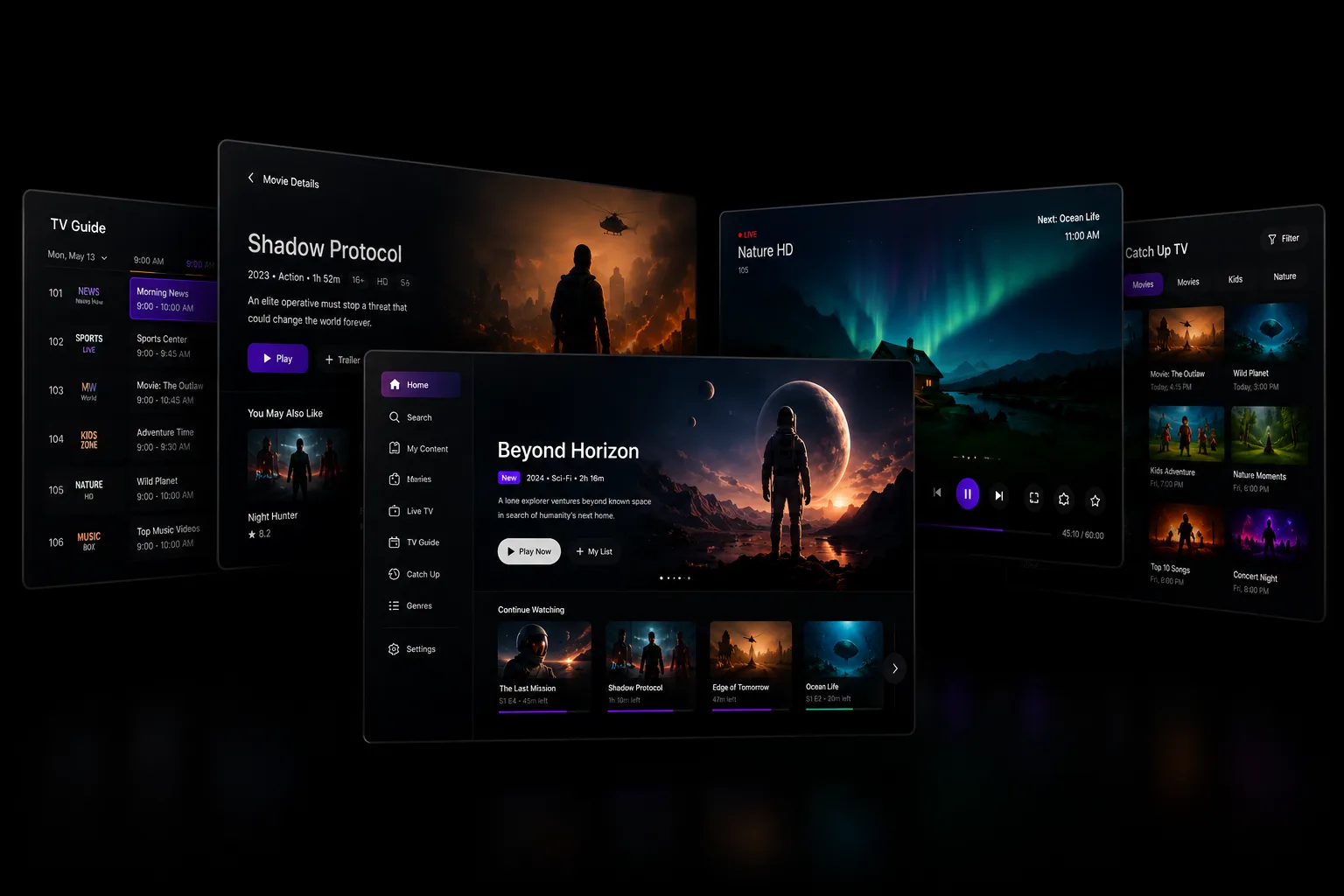
The family you are missing
The living room is a different family, not a bigger phone. A remote instead of a thumb, a focus ring instead of a tap target, a layout read from three metres away. Navigation, focus and playback are rebuilt for it. Your catalogue, sign-in, entitlements and rules are not.
What you get
- Your existing service running on the platforms it is missing, through store approval
- An order to add them in, based on your device data rather than our platform list
- Catalogue, sign-in, entitlements and business rules reused rather than rewritten
- Navigation and playback rebuilt for each platform family that needs it
- Store accounts and territories set up per platform, in your name
Typical timeline
2 to 6 months, driven almost entirely by platform count
Who this is for
You are already live. The app works, people use it, and the question is no longer whether to build one — it is which screen comes next, and what it costs to be on it.
If there is no app yet, building the first one comes before this page.
OTT platform expansion for streaming services
Starts with a phone app and a website that work, and a board asking what the plan is for the living room.
OTT platform expansion for VOD platforms
Starts with a catalogue doing well on one device, and invisible on every other screen the same viewer owns.
OTT platform expansion for broadcasters
Starts with a schedule already reaching televisions over the air, and needing to reach the same screens over the internet.
OTT platform expansion for media companies
Starts with an audience that has quietly moved to a device, nobody has shipped to yet.
What we deliver
The service you already run, on the screens it is not on yet, without starting again.
Consoles and cars are the unusual part. Most studios cover televisions and phones and stop. If a real share of your viewers watch on a PlayStation, or spend an hour a day in a car, those can be part of the same conversation rather than a second supplier and a second procurement round.
What each platform asks for differs quite a bit, and we have written those up platform by platform.
How the expansion runs
We start with your data rather than our platform list. Where your viewers already are decides the order, and the order matters more than the count — two platforms that reach most of your audience beat five that spread the same budget thin.
Then the work reuses what already describes your business. Your catalogue, sign-in, entitlements and rules come across. What gets rebuilt is the part that belongs to the screen: how someone moves around it, and how the video plays on it.
Read your device data
Where your viewers already are decides the order. You almost certainly have this already.
Pick an order, not a list
Two platforms that reach most of your audience beat five that spread the same budget thin.
Reuse what describes your business
Catalogue, sign-in, entitlements and rules come across rather than being written again.
Rebuild what belongs to the screen
How someone moves around it, and how the video plays on it. This is the part that is genuinely new each time.
Submit, certify, repeat
Each platform is its own account, its own reviewers and its own approval to get through.
What actually varies
We do not publish a price. Here is the more useful thing: what moves it.
| Driver | What it changes |
|---|---|
| How your current app was built | An app already sharing a foundation across platforms is a much shorter job than one written for a single device. This is the biggest single factor. |
| Which platforms you add | They are not equal. Some share a family and come nearly together. Others are their own world with their own language and their own reviewers. |
| How far the design carries | A layout built for a thumb needs rethinking for a remote. Design tokens and brand carry; screen layouts partly do. |
| Store and territory admin | Each platform is its own account, its own approval and its own set of territories to configure. It is dull work and it is real work. |
One limit worth saying plainly, because it should change what you ask us for.
Every platform you add is a platform you keep. Operating systems move, stores change their rules, and each app needs recertifying to stay installable. Adding five platforms means maintaining five. If your data does not support a platform, the honest answer is to skip it, and we would rather say that than add it to the quote.
What we need from you
- Your device data. Which platforms your viewers already use is the whole basis of the order, and you almost certainly have this already.
- How the current app was built, and whether you have the source.
- Your store accounts, or the go-ahead to set up the ones you do not have yet.
- A view on which of these platforms is a commitment and which is an experiment, because the two are scoped differently.
You will be talking to the people doing the work, which matters here because the useful early conversation is about which platforms to leave out.
Common questions
How much of our existing app can we reuse?
More than most people expect, and less than a single codebase. Your catalogue, sign-in, entitlements and business rules come across. Navigation and playback are rebuilt for each platform family, because a remote, a controller and a thumb are three different ways of moving around a screen.
Which platforms should we add first?
Whichever your viewers already use, which is a question your own data usually answers. Where it does not, the honest order is the one that reaches the most of your audience per platform added, and we would rather tell you to add two than sell you five.
Do you build for consoles and cars?
Yes. Xbox and PlayStation, and CarPlay and Android Auto. Both are unusual in this market, and in the car the app is audio-first by design, so a music or podcast service is as much at home there as a video one.
What does adding a platform cost us after launch?
Every platform is an ongoing commitment, not a one-off. Operating systems move, stores change their requirements, and each app needs recertifying. Five platforms is five of those. It is the part most often left out of the business case.
Related
Last updated